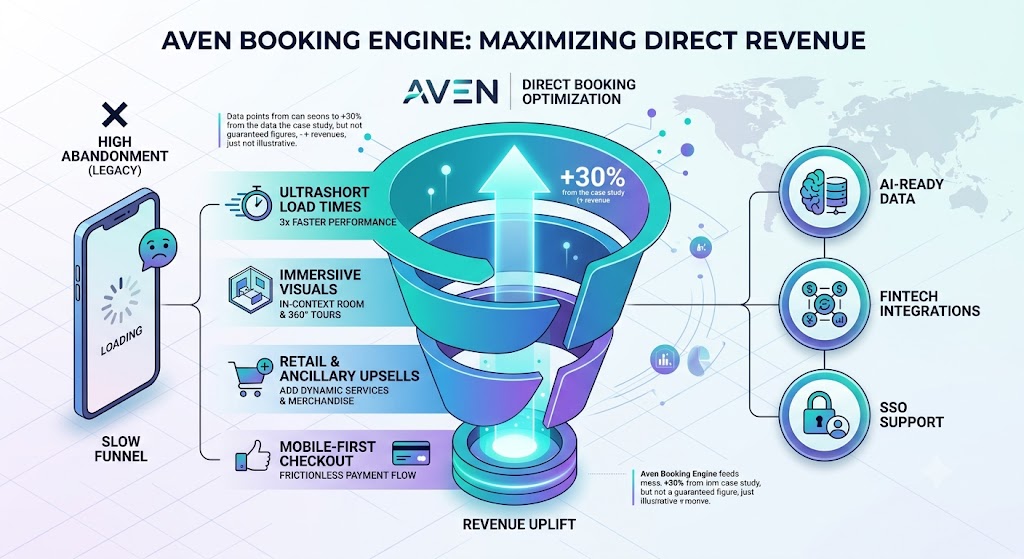
Updated September 2026. The SynXis Booking Engine is the direct online shopping and reservation experience used by hotels in the wider SynXis ecosystem. In 2026, Sabre Hospitality became Aven Hospitality and Aven introduced a rebuilt Booking Engine powered by the SynXis platform. Its job is straightforward: turn website demand into direct reservations while keeping rates, availability, offers and reservation data aligned with the central reservation environment.
This guide explains where the Booking Engine fits alongside SynXis CRS, what changed in 2026, what affects conversion, how payments and retailing fit into the journey, and how to think about pricing without inventing a public tariff.
What is the SynXis Booking Engine?
The Booking Engine is the guest-facing direct booking path. SynXis CRS is the central reservation and distribution platform where the hotel manages commercial data and controls. The Booking Engine uses that information so travelers can search dates, compare rooms and rates, review conditions and complete a direct reservation.
If a room or rate is not sellable because of availability, restrictions, occupancy or configuration, changing the website interface will not fix the root cause. Start with the CRS. My hotel CRS configuration and launch guide covers that foundation.
What changed in 2026?
Aven Hospitality debuted a new Booking Engine in June 2026, describing faster performance, advanced retailing capabilities and a stronger path to direct bookings. Earlier 2026 product updates also described an in-context shopping experience embedded within the hotel website and a new Booking Engine Designer intended to give hotels more control over booking flows.
The practical benefit is continuity from inspiration to shopping. Hotels should still confirm which capabilities are enabled for their own account because rollout, contracted modules and payment services can vary.
How it works with SynXis CRS
The direct journey depends on the setup behind it. Room types, rate plans, availability, restrictions, policies and offers need to be configured coherently before they can be presented well to the guest. When something is missing online, verify the source data before assuming the Booking Engine itself is at fault.
A useful sequence is to confirm that the room and rate should be sellable, verify restrictions and occupancy rules, check offer eligibility, then investigate the shopping presentation. The same discipline applies to wider distribution; see my SynXis OTA connectivity guide.
What improves direct conversion?
Conversion is the combined result of pricing, content, usability and checkout. Focus on the decisions that reduce uncertainty and make the offer easy to understand.
- Room naming: use guest-facing names rather than internal codes.
- Room content: make bedding, occupancy, view, space and inclusions clear.
- Rate clarity: explain inclusions, cancellation and payment conditions before checkout.
- Offer visibility: verify that promotions appear for the intended dates and rules.
- Mobile acceptance: test the full journey on real phones.
- Website alignment: make sure the landing-page promise matches the booking flow.
- Measurement: validate funnel and conversion tracking.
Retailing and ancillary revenue
A modern booking journey can extend beyond the room. Aven positions Retailing as a way to merchandise relevant upgrades, offers and add-ons around the stay. The exact functionality available depends on the hotel's implementation.
Start with a small number of useful, operationally deliverable products. Too many weak extras can create friction. Measure performance and expand deliberately.
Payments and checkout
Payment experience is another part of direct conversion. Available methods depend on the hotel's commercial setup, market and connected providers. Before launch, test successful and declined payments, deposits or guarantees where relevant, cancellation conditions and the reservation data received downstream.
A payment can succeed while the hotel still has an operational problem if the transaction cannot be reconciled or guarantee information is wrong. Treat checkout and reservation delivery as one end-to-end acceptance flow.
AI discovery and the Booking Engine
In March 2026 Aven announced Model Context Protocol enablement across its platform, including SynXis CRS and the Booking Engine. The direction matters because hotel rates, availability and content increasingly need to work across traditional distribution and AI-driven discovery.
That makes accurate source data more important, not less. Room descriptions, attributes, policies, pricing and availability should remain structured and reliable. See my guide to optimizing SynXis content for AI-powered travel search.
What happened to “In-Context”?
The in-context concept is not new to 2026. Sabre announced a SynXis Booking Engine in-context suite in 2015. The strategy was to bring live booking capability closer to persuasive hotel-site content instead of forcing every guest through a disconnected shopping journey.
The 2026 Booking Engine is a newer implementation of that broader objective. Rich media can support room understanding, but it should support the booking journey rather than become the architecture of the journey itself.
How much does the SynXis Booking Engine cost?
There is no single public price I would quote for every hotel. Aven Hospitality does not publish a universal Booking Engine price card for all implementations. Hotels should request current commercial terms and confirm exactly what is included.
When comparing a proposal, check the Booking Engine scope, implementation, integrations, payment services, optional retailing, support and other contracted modules. Two hotels can use the same product name while having different technical and commercial scopes.
Implementation checklist
- Validate representative rooms, rates and stay dates against the intended CRS setup.
- Check minimum stays, closed dates, arrival/departure restrictions and occupancy rules.
- Audit room and rate names, descriptions, inclusions and policies.
- Test promotional codes and restricted booking paths.
- Verify imagery on desktop and mobile.
- Test configured payment and guarantee scenarios.
- Confirm reservations reach the expected downstream systems correctly.
- Validate analytics and conversion events on the live domain.
- Run real mobile acceptance tests.
- Create controlled test bookings before launch.
Common Booking Engine problems
“My rate is in SynXis but not showing online.” Check availability, restrictions, occupancy, eligibility and the room/rate relationship before investigating presentation.
“The website advertises an offer but guests cannot find it.” Verify the entry URL, promotional-code logic, dates and rate eligibility. Marketing copy and CRS rules need to describe the same product.
“The Booking Engine works but conversion is weak.” Review traffic quality, room differentiation, rate competitiveness, content clarity, mobile usability and checkout friction.
“The reservation arrives downstream incorrectly.” Confirm what was sold, what the central reservation record contains and what the receiving system consumed.
SynXis Booking Engine FAQ
Is the Booking Engine the same as SynXis CRS?
No. The CRS is the central reservation and distribution platform; the Booking Engine is the direct guest-facing shopping and reservation experience.
Is it still called SynXis Booking Engine?
Many hoteliers still use that name. In 2026 Aven Hospitality markets its rebuilt Booking Engine as part of the SynXis-powered platform.
Can it sell more than rooms?
Aven's wider retailing capabilities can support upgrades, offers and add-ons, depending on the hotel's implementation.
Is there a public price?
There is no universal public price card I would rely on. Request current commercial terms and compare the exact products and services included.
Final perspective
The SynXis Booking Engine should not be treated as an isolated website widget. It is the direct-commerce layer of a wider hotel technology stack. Conversion depends on the guest experience, but also on CRS accuracy, content quality, payments, reservation delivery and measurement.
If you are planning a new setup, reviewing an implementation or troubleshooting a direct-booking problem, get in touch. The best starting point is usually the complete journey from CRS configuration through shopping, checkout and downstream reservation delivery.